
Any physics. One language.
Open-source computational physics
Eqiora helps researchers and engineers turn mathematical models into simulations, with the physics, numerical choices, and results kept explicit.
Release 0.1.2 · Read the release notes.
From equations to results
Keep the physics in view.
Define the model
Describe quantities, equations, geometry, and boundary conditions. Make the assumptions visible.
Choose the numerics
Select a discretization and solver through a realization, separate from the mathematical model.
Inspect the result
Follow the run into fields, diagnostics, and plots. Trace the result back to the choices that produced it.
One equation, one prediction
Run it. Change it. Understand it.
For dx/dt + kx = 0 with x(0) = 1 and a decay rate of one per second, the model predicts x(1) = exp(-1) ≈ 0.367879. Install Eqiora, run the model, then double the rate and test your next prediction.
Featured walkthrough
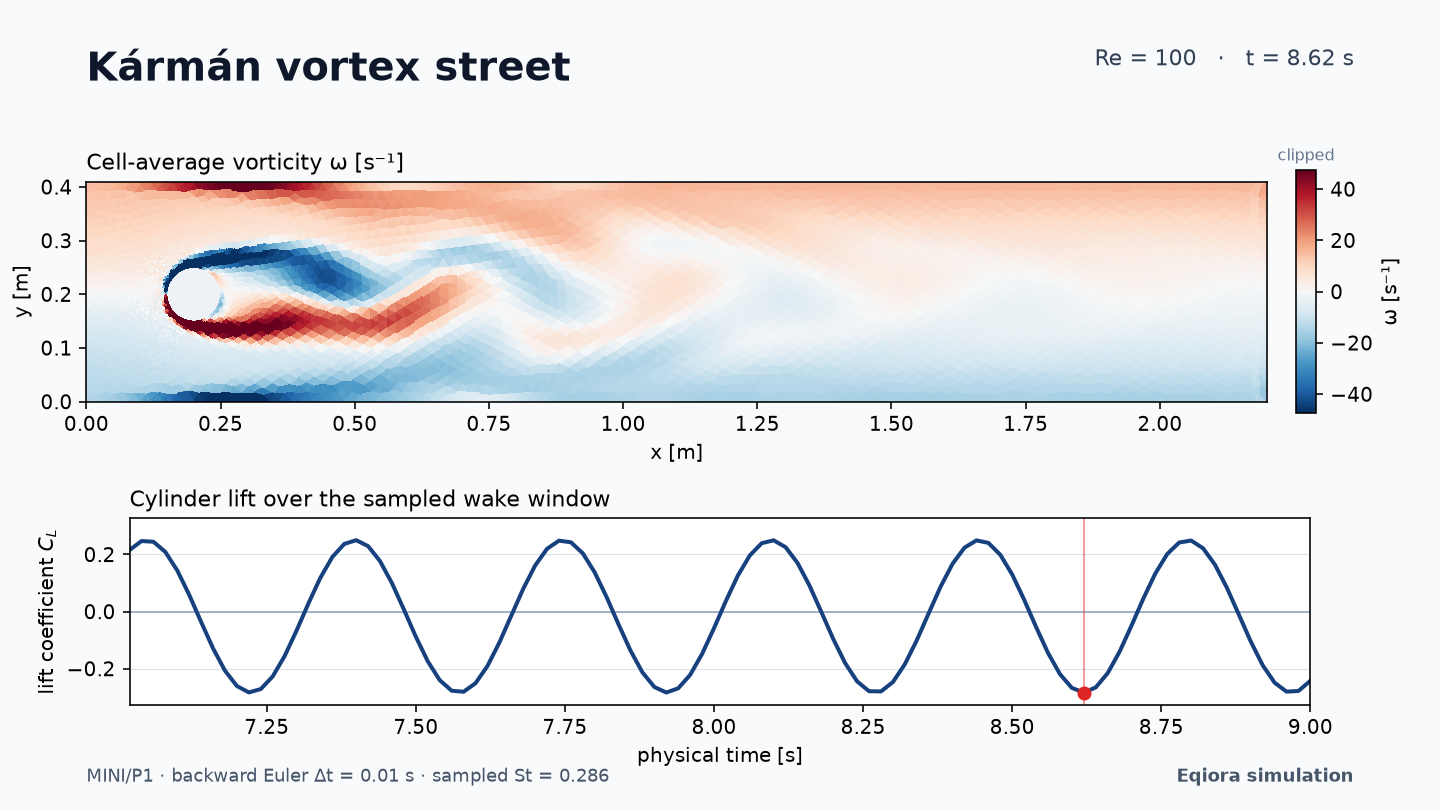
Follow a flow simulation, end to end.
Follow the Kármán vortex-street example from exact channel geometry and named boundaries to an evolving vorticity field. Read the source, numerical setup, and result together.
Explore the flow exampleGo further
Find your next step.
Get started
Install with uv, run a small model, and change one parameter.
Learn
Work through derivations, physical examples, and exercises.
Guides
Author a model, choose numerics, inspect results, or diagnose a failure.
Gallery
Follow a complete investigation from physical setup to result.
Standard library
Reuse electrical components, sampled controls, fluid and solid laws, and boundary conditions.
Browse the reference
Find language examples, physical components, Python and Rust APIs, and CLI usage.
Contribute
Improve an example, develop a numerical method, or help shape the tools.